Greetings from Cabot Cove
For years before I got my first tattoo, I heard people talk about how addictive it can be. Not for me, I’d smugly think. One and done…I got my tenth tattoo this past summer. It’s the potato chip effect–you can’t have just one. And apparently it applies to all sorts of other parts of my life. Tattoos, potato chips, writing books. He publishes one little book and suddenly he’s an “author.” I know. I hear that voice every day. In fact, I never set out to write “a book.” I just started writing, and after a while, especially at the encouragement of friends whose judgment I trust and whose confidence both rattled and settled me, I stepped back to see if the lot of short essays I’d written could somehow stack into a book.
The book brought me great personal satisfaction–I don’t pretend that I have an interesting enough life to merit a memoir or that I’m skilled enough with words to create “art,” but it was a large project that emerged from something I wanted and that I completed. It’s taken me almost fifty years to get to this point–trusting my instincts, following my desires, and sticking with it. In the past, my experience was, well, what’s the old joke about Catholic priests? Most take vows of poverty, chastity, and obedience, but for the Jesuits, two out of three ain’t bad. #rimshot For me, the book was the first time I completed that triad–something from me, something I wanted, and something I did (with substantial personal and editorial support…sorry, I’m really not good at self-promotion, and credit is due where deserved). Apparently that hattrick was another potato chip…if I could do it once, I could do it again, right?
This time around, though, I really do have a coherent idea for a book. For months, I’d tried to work on it piecemeal, a little bit at a time (which was largely how six to carry the casket came about), but I couldn’t build momentum. In part, there were too many immediate distractions–I work from home, and the daily struggle toward productivity is heavily hampered by the thousand things to do around the house.
In part, I was also trying to do too much at once. I often say, lightly though with sincerity, “Multitasking is hard.” Let me tell you, when I learned in a class about education and the brain that multitasking is a myth, I felt the greatest of burdens and self-disappointments melt off my shoulders. It’s not just me. Yeah, when we think we’re multitasking, we’re really just monotasking and switching back and forth rapidly, which means we don’t do anything 100%, we don’t reap the benefits from any individual task, and we ratchet up the stress experience.
And, in part, I wasn’t really investing in the project. Nagging fears were pulling me back, fears that the book isn’t necessary, that I don’t have the perspective I think I have, that I don’t have the expertise I should have, and I withheld putting anything into the project–time, energy, effort, money. If this book was going to happen, if I would be able to taste that second chip and say for the second time that I’ve got something from me, something I wanted, and something I did, I needed a different setting, I needed blinders, and I needed to invest.
So here I am on a little writing retreat. I’m far enough from home that I can’t make up an excuse to pop back but not so far that it was a struggle to get here. I’m not watching television, which means no Drag Race spoilers for a bit, thank you very much. I’m not on soci…I’m minimizing my time on social media (avoiding spoilers is actually a great method to reduce screen time). I’m rereading things I’ve been thinking about, things that I want to inform this book. And I’ve given myself about three weeks, a span of time I’d only previously devoted to vacations. I’ve done probably thousands of retreats over the years–as a retreatant, as a retreat leader, as a retreat director; some spiritual, some professional, some community builders–so getting into retreat mode is pretty easy for me. The difference is that I want to produce something this time.
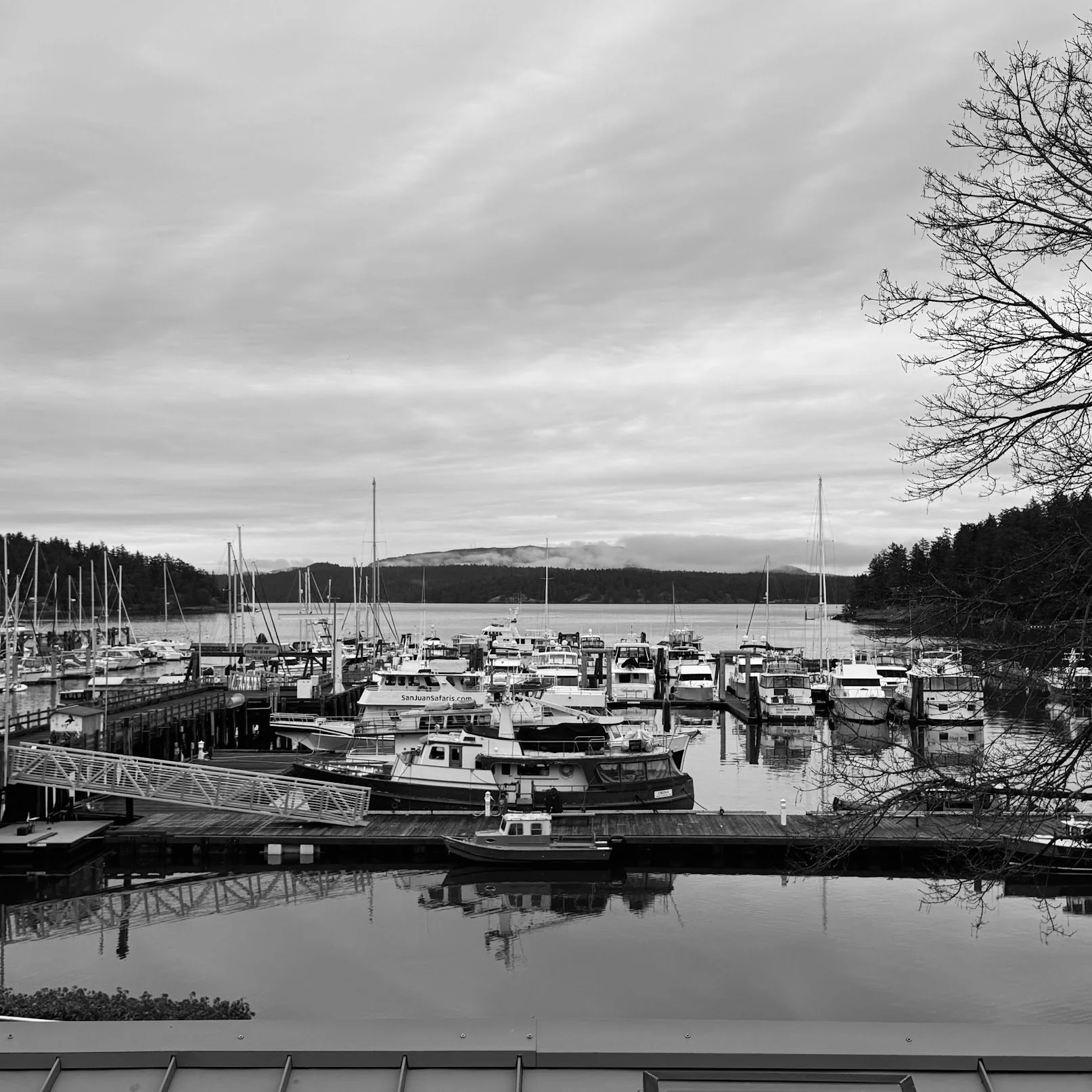
When exploring my options, I was watching a lot of Murder, She Wrote (on laundry days, I alternate between it and The Golden Girls). I thought to myself, if a small seaside town is good enough for JB Fletcher, it’s good enough for me. So I found Cabot Cove. It’s not actually Cabot Cove, but this little harbor town in the San Juan Islands is giving me Murder, She Wrote vibes in all the best ways (the delightful melancholy of the setting, not all the murder). Walking around town, though, I started to understand how this place has retained that vibe. Human development (the construction kind, not anatomy and psychology) is in harmony with its natural setting. Every human settlement approaches a point that forces a decision on its community–to step back and look to the natural setting for the right flow, the right proportions, and maintain harmony, or to trample it, to remake it, and introduce a new melody. Somehow, this little island has fended off the instincts that ruined once-harmonious-with-nature paradises like Capri and the Cinque Terre.
As a nine year old, I visited Taliesin West, Frank Lloyd Wright’s home and studio in the Arizona desert. It’s an experience that continues to shape me. That first visit prompted a lifelong obsession with design and architecture, but even more importantly it introduced me to the concept of organic design. FLW didn’t always practice what he preached, but he promoted keen insights about how to build in harmony with natural settings. The tour guide enthusiastically described Wright’s design inspirations in the natural formations of the desert and the dwellings of local indigenous folx, but what really blew my mind was how he shaped spaces around the human experience, not around abstract aspirations and forms. Our guide explained how Wright would sit at a concert or in a cabaret with his legs crossed, which ever so slightly shifted the position of his torso, but Wright was frustrated by most theaters because audience seats were conventionally placed perpendicular to the stage. In his Cabaret, Wright set the rows of seats on an angle, making it more comfortable to sit casually and enjoy the show (well, if you adopted the same posture as he). He also designed transitional spaces with lower ceilings and narrower passages, which subtly encourage people to keep moving, giving his spaces the power to communicate and shape interactions. Designing in harmony with the natural setting and around the person, not bending the person or the environment around the design, has been a treasured principle for me ever since, one that I’ve translated into a pithier mantra: the person is infinitely more important than the institution.
This principle once motivated my work in schools, and now it fuels my work in ritual design. In fact, I think this principle is driving the whole book that brought me up here. Yeah, yeah, yeah…has he mentioned what the book is about yet? Weddings. I am working on a guide to designing a wedding that reflects the experiences, identities, and values of the people at the center. It’s not a “planning” manual; instead, it will help to-be-weds identify what’s important to them and develop a critical lens to make choices for a ceremony and adjacent celebrations that actually align with their values.
How is that different from all the other wedding planning guides out there? Well, most wedding planning starts with the standard components of the American Wedding. While talented and open-minded officiants and planners often help couples with aesthetic tweaks, they rarely question the structure and assumptions driving the American Wedding. Here’s the problem: so many of the things we associate with the American Wedding originated in very different places and times, and they carry with them values that really don’t resonate today. That means we’re both perpetuating outdated and harmful values and reducing wedding ceremonies and festivities to anachronistic photo ops. Sure, this makes weddings predictable and profitable, but it also makes them inauthentic.
My goal in designing a wedding is creating a moment that reflects the experiences, identities, and values of the people at the center. That kind of wedding requires that to-be-weds know what’s important to them and develop a critical lens to make choices for a ceremony and adjacent celebrations that actually align with their values. I’m not out to destroy the American Wedding or pick a fight with the Wedding Industrial Complex, but I do want to offer people the tools they need to have a wedding that actually feels like them and doesn’t squeeze them into ancient and troubling moulds.
This isn’t just self-serving. In fact, if it’s effective, I might be writing myself out of a career. But I believe that weddings provide an unparalleled opportunity to change the world. Mm…a bold claim. People love weddings, or they love to hate weddings. They show up because they want to be there. When a couple exchanges vows and does ritual actions that seal their marriage, like exchanging rings or lighting a candle, people are paying very close attention because they love the people at the center (or like them enough to show up) and because, despite what Rue McLanahan and Elizabeth Taylor might have us believe, people don’t get married often. The couple at the center has an opportunity—dare I say, obligation—to communicate what’s important to them. They can create their ideal world and invite family and friends to get a taste of what their marriage and their home will be like. If they aspire to be like European royalty, if their marriage will conform to the expectations of 19th century Protestantism, if they’re happy sustaining the infantilizing myth of the “queen for a day” and the radically misogynist handover of a woman by her first owner to her new owner (yeah, that’s the origin of the father of the bride’s vaunted walk down the aisle), great. Imitate Queen Victoria with a white dress and a grand entrance. Do the traditional wedding.
But if not…don’t. You don’t have to reject every practice and start from scratch, but with intention and care, you can adapt or reframe customs with sentimental pull, or you can replace them by creating new traditions that echo the unique blend that is your relationship. You can design something that says to the world not just “we’re married.” You can design something that says “we’re married.”