I still hate Santa.
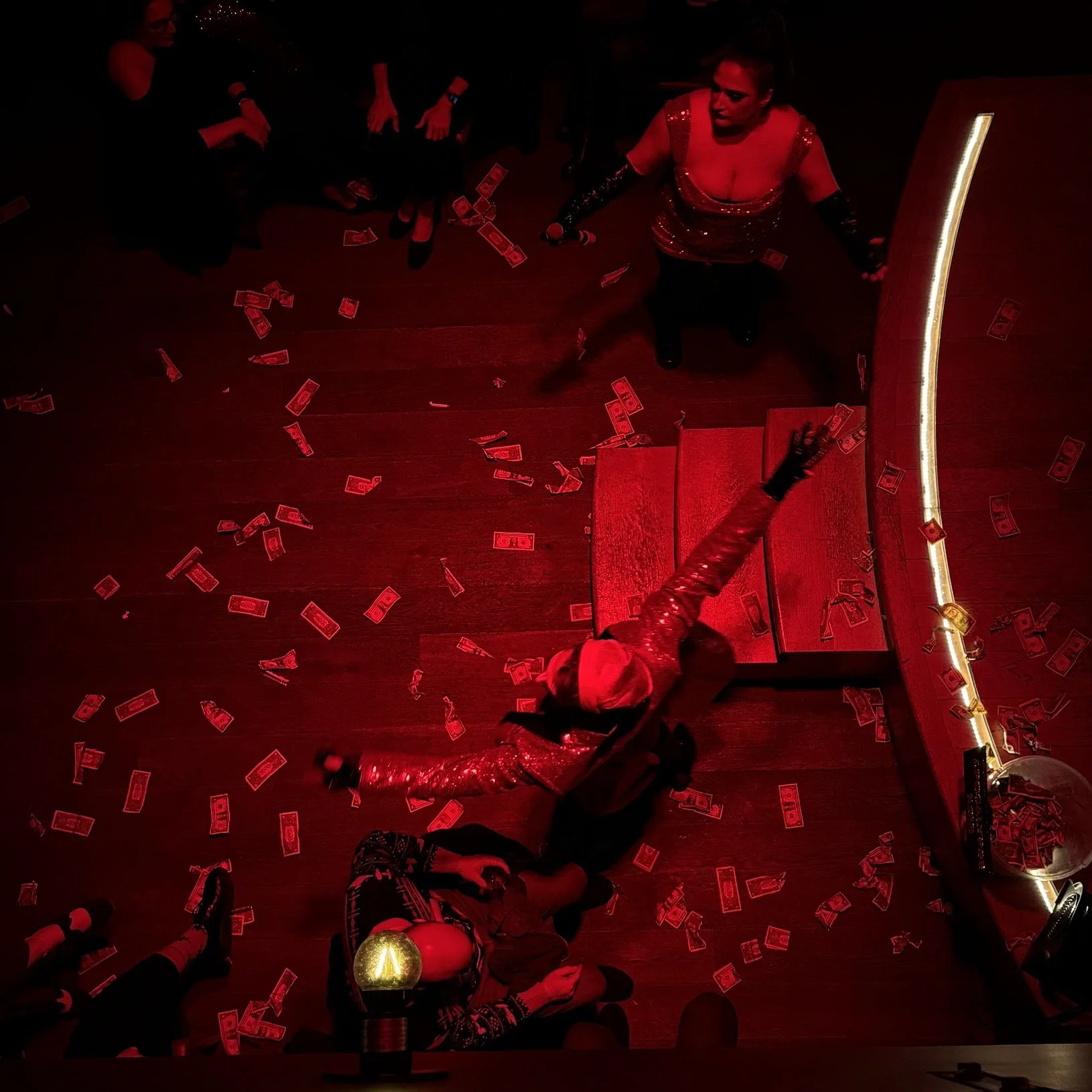
Andrew Barrett Cox at Balcon, December 8, 2025.
With the holiday season in full swing, at the end of what can only be described as a tumultuous, painful, and painfully absurd year, I’m reminded of an essay I wrote five years ago during the height of holiday festivities during another absurd and absurdly painful year. Nine months into quarantine, I had a lot of time to think about things. I wrote about the vivid and blurry memories and wide range of feelings that surface with the installation of a Christmas tree at that time, too–“how to put up a Christmas tree” made it into six to carry the casket and one to say the mass. That essay, though, neglected the thing about the holiday season that enrages me. I saved my seasonal vitriol for “Here’s an unpopular opinion: I hate Santa.”
Well, here’s an update. I still hate Santa. What follows is a return, revision, and expansion of my earlier argument. If you, too, need a space to channel some rage at this time, rational or otherwise, follow me down Candy Cane Lane.
I inherited an ambivalence about Santa Claus from my mother — she wasn’t one to rock the boat (or in this case, the sleigh), but she sure did stay firm on her convictions. She never actively perpetuated the Santa myth–but she didn’t negate it, either. On Christmas morning, gifts appeared under the tree, but the To: and From: sticker, adhered to the upper left corner of the top of the wrapped package, only revealed only the name of the recipient, the From: left mysteriously blank. And the handwriting was, indisputably, my mother’s, a distinctive and graceful variation on the Palmer Method–you know, the examples taped up above the chalkboard and lockers in every grade school classroom, back in the days when they taught us pioneering survival skills like cursive and how to address a postcard.
For my mother, Christmas traditions included lighting the candles of an Advent wreath at the start of dinner, a special trip to have lunch in the shadow of the tree in the Oak Room at Marshall Field’s, stapling holiday cards to long strips of ribbon and hanging them over the doorways in our front hall, and setting out the variety of Nativity scenes the family had collected over the years. On the Feast of St. Nicholas (you know, the historical Santa Claus), I’d leave a pair of shoes in the hallway and wake up to find a candy cane and an orange where my feet should’ve been. Santa, though, was just not part of her aesthetic.
Some of you have already judged us and assigned us humbug status, but here’s the upside: when I learned that Santa (and therefore other corollary figures like the Easter Bunny and the Tooth Fairy) wasn’t real, around second grade, I wasn’t devastated. My worldview was not shattered. I was not confronted at a tender age with the fact that the shocking reality that the adult world conspired to weave a web of lies that dominates everything, all the way up to the highest levels of government. Seriously–the United States Postal Service and NORAD have sustained the myth for decades. I was not confronted with the devastating reality that the agents on the frontline of this scheme were my parents.
My mother was wise not to make a stink about such things —she might offer her opinion through a few pithy proverbettes, like “It just teaches children greed” (her opinion on Halloween) or “Don’t you people know we had a revolution?” (her response to Americans obsessed with British royalty)--but she was loath to pop the innocence bubble for other people’s children. Doesn’t everyone remember the time they put it together, or when an adult slipped, or when another kid, some balloon-popping asshole who probably turned into one of those social media trolls who just loves to spoil plots and winners for everyone, dropped the truth bomb? Yeah, we remember it because it was traumatic. Like Mom, I’m not interested in correcting anyone else’s parenting.
As an INFJ Virgo, I do have a tendency to proceed through life with a burning desire to tell others, “you’re doing it wrong.” I’m working on it, and promise to do better. #thoughtsandprayers But I also believe firmly that the way to effect real, just, and sustainable change in the world starts with individual choices. So here’s my argument for, during the holiday season and all through the year, making a different choice when it comes to perpetuating the Santa myth.
A matter of Myth vs. History: Santa Claus is based on the historical figure, Nicholas of Myra, a third-fourth century CE Christian bishop in modern-day Turkey, and his story has nothing to do with Christmas. As the story (that doesn’t often get told) goes, Nicholas secretly left money for a family whose poverty would have forced them, without dowry, to sell their daughters into slavery. There are other stories about him that inspired his veneration and, ultimately, canonization, but this is the root of his status as a patron saint and protector of children. His feast day is popularly observed because he embodied virtues important to Christian practice, not because of its occurrence within the Advent season . A feast day marks the anniversary of a saint’s death, so if St. Nick of Myra had held out til spring, maybe he’d have been the face of Easter instead.
Origins in Modern Marketing: Santa Claus, as we know him, delivers no deep moral insight. He is a glorified marketing tool that embodies the consumerism that dominates the season and that so many purists have lamented for so long–the “Christmas has gotten too commercial” and “Jesus is the reason for the season” set. In the late nineteenth and early twentieth centuries, Santa Claus started to evolve into the jolly figure we know today, and that image was adopted for ad campaigns for Coca-Cola. No, Coca Cola didn’t invent the modern Santa…but they sure did help to promote him and secure his place in American psychology…
…with devastating consequences... For example, Santa’s is the face of lies. No, Buddy T. Elf, he doesn’t just sit on a throne of them; he is the throne. At a tender and vulnerable time of year (you know, winter), in the most tender of acts (you know, giving a gift), parents lie to their children. Why? To uphold a myth that a strange fat man who lives in the Arctic is going to break-and-enter their home to leave objects that tell children whether they’ve been “good” or “bad.” What the…I mean, what’s wrong with kids knowing that their parents and caregivers are generous and thoughtful, that their parents are the source of their anticipated joy?
…including the reinforcement of a false ethical binary.: The “good” or “bad” thing. I mean, I wouldn’t exactly call this “growth mindset.” It perpetuates behaviors and a general culture that rewards behavior deemed “good” with bounty and that punishes behavior deemed “bad” with deprivation. In recent years, the Elf on the Shelf, that nastiest of Santa-myth-outgrowths, has appeared in homes to terrorize children, to let them know that they are being watched, that they are not to be trusted. You’ve already prepared them for the Man with the Bag to break in at night, to leave food and drink to appease him and secure his boon. Now you welcome his spies into your home? If my parents had performed this ruse, I’d still be afraid of dolls, figurines, and statues. Along with the Easter Bunny and the Tooth Fairy, perpetuating the Santa myth constructs a fantasy in which kids learn to behave for the mystically powerful who can satisfy their immediate desires — not to demonstrate respect and empathy year round for their parents, siblings, caregivers, teachers, friends, strangers, or, frankly, for themselves. You know, real people.
Retail Santas are just, so…ugh…: Even my beloved Blanche Devereaux lets me down–she famously declared, “There’s something about a man in a Santa Claus suit that just drives me absolutely crazy.” Me, too, gurl. Just a different kind of “crazy.” Retail Santas, the ones in department stores and malls, are the clearest evidence of Santa’s roots in consumerism. The original purpose of Retail Santas was not to give every child a moment where they feel seen and heard (again, why couldn’t their parents and other caregivers fill that role?) but to plant in children’s desires the roster of items already in stock. Santa seals the deal for marketing campaigns that promote trends and whip up frenzy to acquire those special items. They are cogs in the machinery of capitalism, driving up demand so retailers can maximize their profits. Ho, ho, ho.
…also, creepy…: Let’s go deeper into interacting with Retail Santa, AKA “encouraging children to tell strangers about their hopes and desires.” In his stand-up special “Kid Gorgeous at Radio City,” summoning memories of school assemblies, John Mulaney observed, “You are gathered together as a school and you are told never to talk to an adult you don’t know and you are told this by an adult that you don’t know.” The same logical acrobatics apply here. We tell kids not to talk to strangers. We tell kids to respect their and others’ bodies. We tell kids to say ‘no,’ to listen to those instincts. And then we wait in line, build the anticipation for their one shot to demonstrate their worthiness to the Wizard of Oz, and then drop them in strangers’ laps (the same laps where dozens sat before without a sufficient Purell or Febreze break in between #gross #nowondereveryonegetssickindecember) and tell them to bare their souls. The same stranger who is going to sneak into their house at an unknown hour to leave them either coal or a pony. Now, much of my reaction to the Santa myth is tongue in cheek, but this is one I treat with great seriousness. I’ve seen enough kids look terrified and uncomfortable in photos-with-Santa, and, worse, I’ve seen enough adult men use the ruse to be able to interact with young women in, shall we say, un-Christmaslike behavior.
…and dull.: The extended web of lies, that is, the broader set of stories, movies, and music rooted in the Santa myth is rarely original or nuanced. Let’s consider a few classics: Miracle on 34th Street is a contrived romantic comedy that revels in the glories of department stores and uplifts kids who proceed with blind trust in the adults in their lives (including the strangers!). The Polar Express is a cute little story (that should’ve stuck to the pages and off the screen) with a penultimate message to “believe.” In what? In Santa? In jingle bells? Back to #3. And any story that involves Mrs. Claus (does she even get a first name?) just props up the patriarchy. God forbid we should have one story to tell kids that doesn’t reinforce outmoded gender roles.
If a Santa-rooted story does deliver a solid moral truth, that truth is not dependent on or exclusive to Santaland. The beloved Rudolph the Red-Nosed Reindeer escapes my wrath because the movie highlights bullying and exclusion and plants a little hope in the hearts of viewers experiencing bullying and exclusion. Rudolph’s difference is the source of his power; Hermie escapes a life of sweatshop servitude and pursues his dream (to be a dentist); the misfits find and bolster each other. Those stories could’ve been told using any context, and they use the Santa myth as a vehicle to a deeper truth. Instead of inculcating belief in flying reindeer in a realistic presentation, the stop-motion animation style of the film echoes a child’s imaginative play with a set of dolls.
A caveat, just to prove I’m not heartless. There are two movies rooted in the Santa myth and dependent on a Christmas context, that escape the trappings of Santaland…and my wrath: Elf and A Christmas Story. With Elf, it’s hard to imagine a better construct for a fish-out-of-water and find-your-true-purpose comedy than an oversized elf returning to the world of humans. Sure, it doesn’t demonstrate that Santa is a construct, but it doesn’t double-down either. The feel-good moments in the movie are focused on human-human relationships. Like other pieces of magical realism (yes, I just put Elf in the category of magical realism), the movie doesn’t expect us to perpetuate a false myth–it just invites us to suspend our belief until the credits roll. And A Christmas Story is really a coming-of-age story that captures the (early-20th century) naivete, wonder, and awkwardness of burgeoning adolescence. Instead of perpetuating the Santa myth, though, the film reveals, really emphasizes, that it is his parents, not the Hourly Santa and his unionizing elves at Higbees, who know and love Ralphie and give him what he needs. In the audience, we get to admire his folks for their anonymous kindness, especially his father’s soft-spot for an official Red Ryder, carbine action, two-hundred shot range model air rifle, but Ralphie doesn’t. He falls asleep on Christmas night with the knowledge that Santa delivered, even though he did almost shoot his eye out. Sorry, #spoilers.
Ok, back to complaining.
The contradictory Christiancentrism of it all…: I once visited Tokyo in December, and I was shocked upon arrival to see Santa-centric Christmas decorations everywhere. The mood of the decorations and branding, though, was a little different–unlike the charming, quaint, and wholesome aesthetic of the Hallmark Channel, Christmas in Tokyo is romantic, akin to American Valentine’s Day (yeah, that’s a rant for another day…talk to me in February). As a jet-lagged tourist, that was disorienting enough, but I was overwhelmed by the reality that, in a world where we’re struggling to understand how to navigate and meet the challenges of a pluralistic world, the Santa myth that travels with American-style consumerism carries with it and imposes onto other cultures Christian tradition and all the baggage that comes with it. That means that Santa–whether Pere Noel is inviting children to sit on his lap in Paris or encouraging you to sit on someone else’s, um, lap in Tokyo–joins a long line of evangelizing efforts like the Crusades and the European colonization and subjugation of Africa and the Americas that conflated political, economic, and religious ambitions. Yeah, Merry Christmas. And yet…here’s the weirdest part of the whole thing: the modern Santa Claus only exists in relation to Christmas; Christmas only exists in relation to Christianity; but, beyond its very distant roots in Nicholas of Myra, Santa Claus has nothing to do with Christianity.
…and we’re all complicit.: Christian observance of Christmas has dominated winter for a long, long time, but our experience of pluralism in the modern and postmodern world should give us an opening to recognize multiple ways of making meaning out of the darkest, coldest time of the year. And didn’t our experience in 2020 and the devastation that followed teach us anything about the need for trust, for empathy, for generosity in the world? Instead, Santa dominates the winter calendar and economy, leaving Diwali, Chanukah, Kwanzaa, Yule, and other winter observances to duke it out for the little bandwidth left. So far, it’s not written into law, but it’s a clear expectation for all citizens to uphold this myth, whether or not it has anything to do with the world or our lives. We are all called into complicity.
And a grudge.: And besides, I wrote to Santa for a My Little Pony when I was 7. I’m still waiting.
Case closed.