A confession.
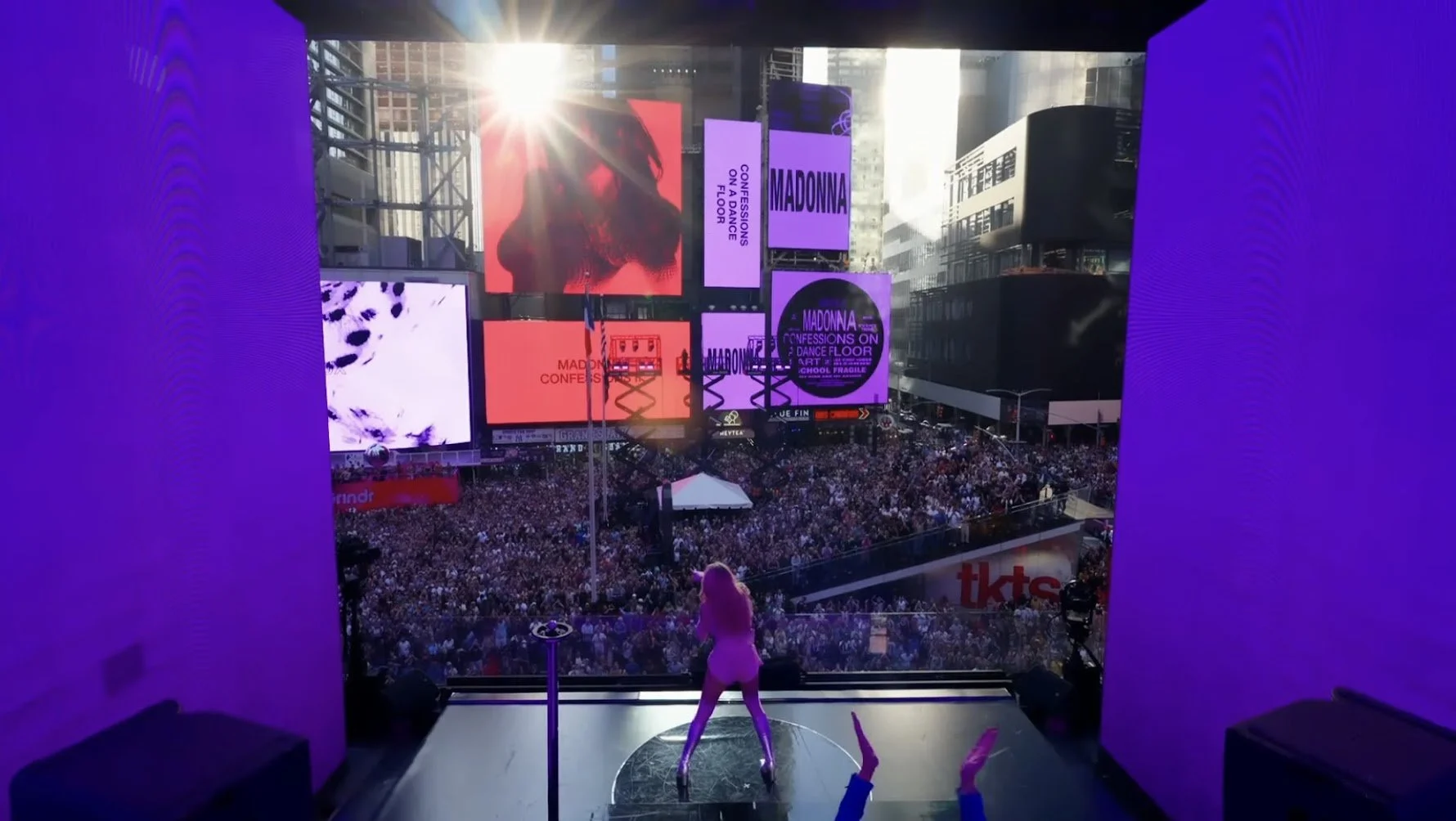
Screen capture from the Grindr livestream of Madonna’s June 4, 2026 pop-up concert.
Forgive me, friends, for I have sinned. It has been over fourteen weeks since Madonna released “I Feel Free,” the opening track of Confessions on a Dance Floor 2, and I have not publicly opined about this first, delicious taste of the highly anticipated album.
I’ve said nothing about the rumored, actual, and surprise collaborations on the album, about the lingering hints of collabs that might show up elsewhere (please, Kylie Minogue, come through!!), or about her partnership with Sabrina Carpenter to introduce the album to the Coachella set and the children.
I have been silent about the brilliant and narrowly targeted campaign to her most loyal fan constituency, the gays, which included releasing that first song on Pride Radio, benefits for Grindr members like a special edition vinyl of the album and an exclusive livestream of her popup performance in Times Square, and showing up at the ever-so-popular WeHo venue The Abbey to introduce the album to a mix of queer patrons and drag royalty. I haven’t even donned my ritual nerd hat to gush about the truly inspired ritualization of the rollout. It wasn’t just marketing – it was liturgical! I mean, she insisted that we all tune in to Pride Radio at a certain time to hear the song, and within a minute, Madonna invites us to the dance floor (both the metaphorical one and a very specific place, the iconic Danceteria). By steering people with a commonly claimed identity to join a niche event – even by livestream – she created a unified, simultaneous experience for a virtually connected crowd who would become a new community, the first fans of C2. It’s fucking textbook ritual design for the postmodern world.
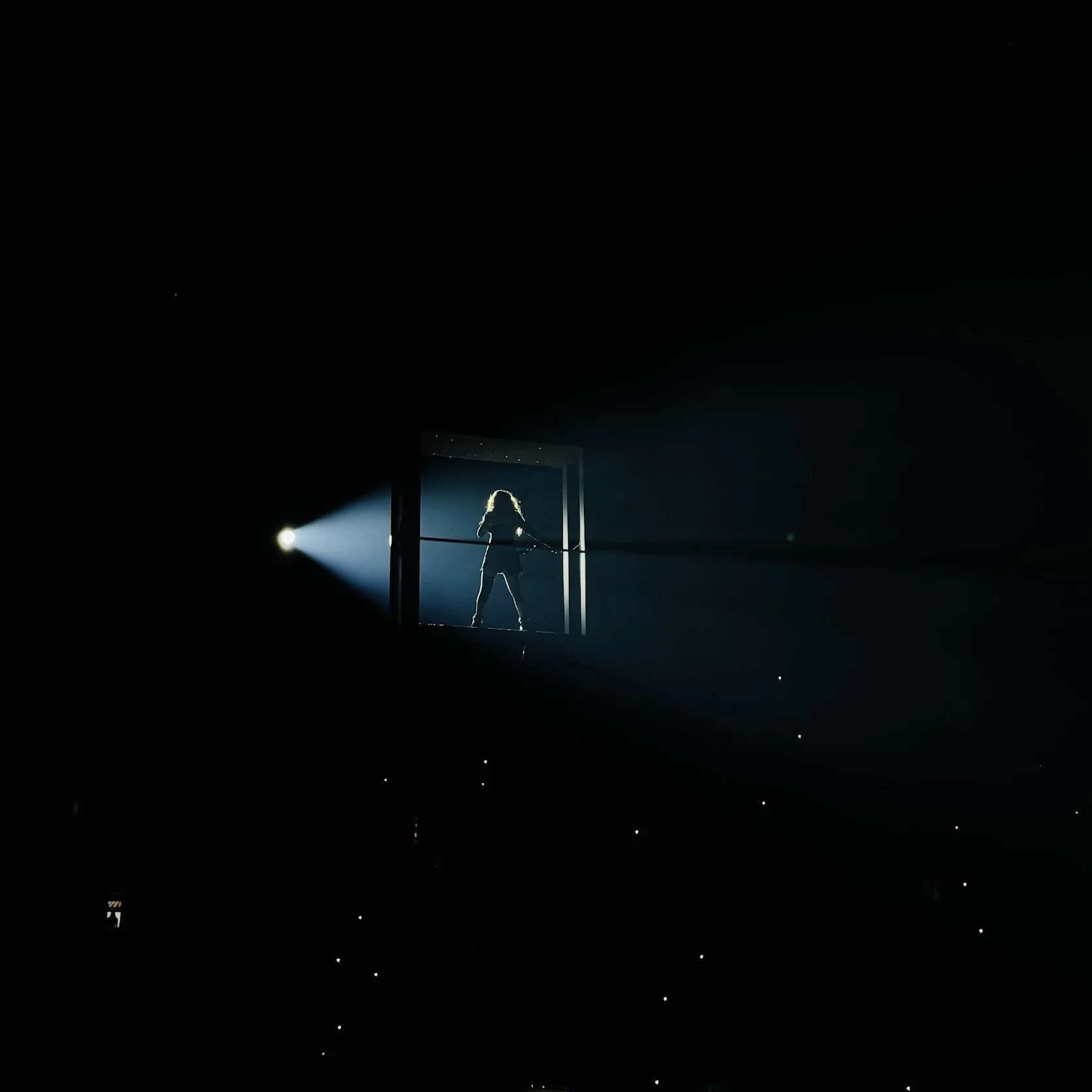
Madonna during The Celebration Tour (Seattle 2024).
I have yet to describe my first listen of the album while dancing in my kitchen like I was 23 and on my third Stoli & soda at ManRay. “I’ve never seen you this…active…this late,” said my husband, with accidental shade. It didn’t bother me, because the ritualized rollout made me hear and feel the album as a peak ritual experience. Like all of Madonna’s albums, C2 isn’t just an anthology of discrete songs; it’s a holistic experience with a discernible narrative and emotional arc that invoked for me memories of those perfect nights out. You know, those nights when you felt cute and the music was right and the friends were there and the crushes and the exes and the tourists all mingled. Those nights when sex and friendship and community and intimacy and rage and impatience and courage all swirled. Those nights when you never got tired, just more curious about what the next hour would look like, what the world would look like after that kiss or that fight or that fuck or that perfect cigarette. Those nights that brought late mornings, rude awakenings, and deep pondering, fixation even – did that really happen? Those nights that made you see the world differently, that made you see yourself-in-the world differently.
And in the weeks since the full album dropped, I have yet to don the academic robes from the School of Madonna Studies to theorize, to wax poetically, to get downright irritating in pointing out obscure references and parallels. I haven’t reached out to friends and strangers to unpack the thesis that opens the third track, “One Step Away.”
People think that dance music is superficial, but they’ve got it all wrong. The dance floor is not just a place. It’s a threshold, a ritualistic space where movement replaces language.
And even with that explicit framing for the album, I still haven’t shouted from the rooftops that this was my working thesis throughout all of divinity school; nor have I deconstructed it as a ritualist. I mean, come on. It’s just sitting there, and Bill is silent? The opening tracks are celebratory, welcoming, like a gathering song even…and once we’re in the groove, Madonna poses her thesis. The rest of the album explores the language and liminality of the dance floor, both literal and metaphorical, and meditates on the relationships shaped there, but instead of just describing it, C2 offers an experience, a journey to the heart of the album where she does, in my humble opinion, some of her richest theological reflection to date.
Theological, he said? Yes. I think of Madonna as a public theologian who uses her artistic medium and celebrity platform to pursue ultimate questions. With C2’s thesis statement, Madonna directly confronts the assumption that “dance music is superficial,” but she’s been challenging that assumption from the start through her own music. The hatiest of haters can’t deny that Madonna is masterful with the pop hook, but I’ve always looked to those hooks as mantras or chants, pithy and packed distillations of broader spiritual truths or inquiries that Madonna integrates into her music. C2 is just the latest installment of an epic series (think of every album as a tome) throughout which she has consistently looked to the sacred and liminal space of the dance floor as a place of transformation and transcendence. Every hook, every Madonna mantra, points to the theological vocabulary and framework she has been developing for decades.
Until now, in my humble opinion, Madonna set the bar for theological reflection in the heart of another album. Bedtime Stories creates a different but no less ritualized arc that climaxes in, well, “Bedtime Story” and the masterful video that accompanied it, which blended Jungian psychology and the surreal art of Remedios Varo, Leonor Fini, and Leonora Carrington with contemplative practice and a compelling beat. Throughout that album, we chanted along along with My baby’s got a secret, Express yourself don’t repress yourself (not to mention its effervescent companion I’m not your bitch, don’t hang your shit on me), and Love tried to welcome me, but my soul drew back. Then Madonna shifts gears in “Sanctuary” and prepares us to let go of words and logic, of superficial reason, to discern what and where and who and what purpose is driving it all. We join in the refrain of Let’s get unconscious, honey. Let’s get unconscious. And there, away from the world, she proclaims her big revelation:
Words are useless, especially sentences.
They don’t stand for anything.
How could they explain how I feel?
It’s laughably simple – unless you’ve been on a dance floor (or its metaphorical equivalent, whatever space has seduced you into letting go and falling into rapture and bliss). If you have, then you recognize that moment where the world melts away. Because it’s ephemeral, we write it off as a fantasy, a cloud we’ll never catch, and therefore insignificant, but Madonna redirects us precisely to that moment to find what we need beyond the boundaries of the (cisheteronormative patriarchal capitalistic) world that we live in. As the new mantra sinks in, we hear Traveling, traveling, almost a whisper to remind us that we’re on quite a trip. The satisfaction of the undeniably erotic and sexiest of her albums is tied to liberation. The album resolves and releases its listeners with a ballad and the refrain of “The show is over, say goodbye.” Does it get any neater, any more ritual than that?
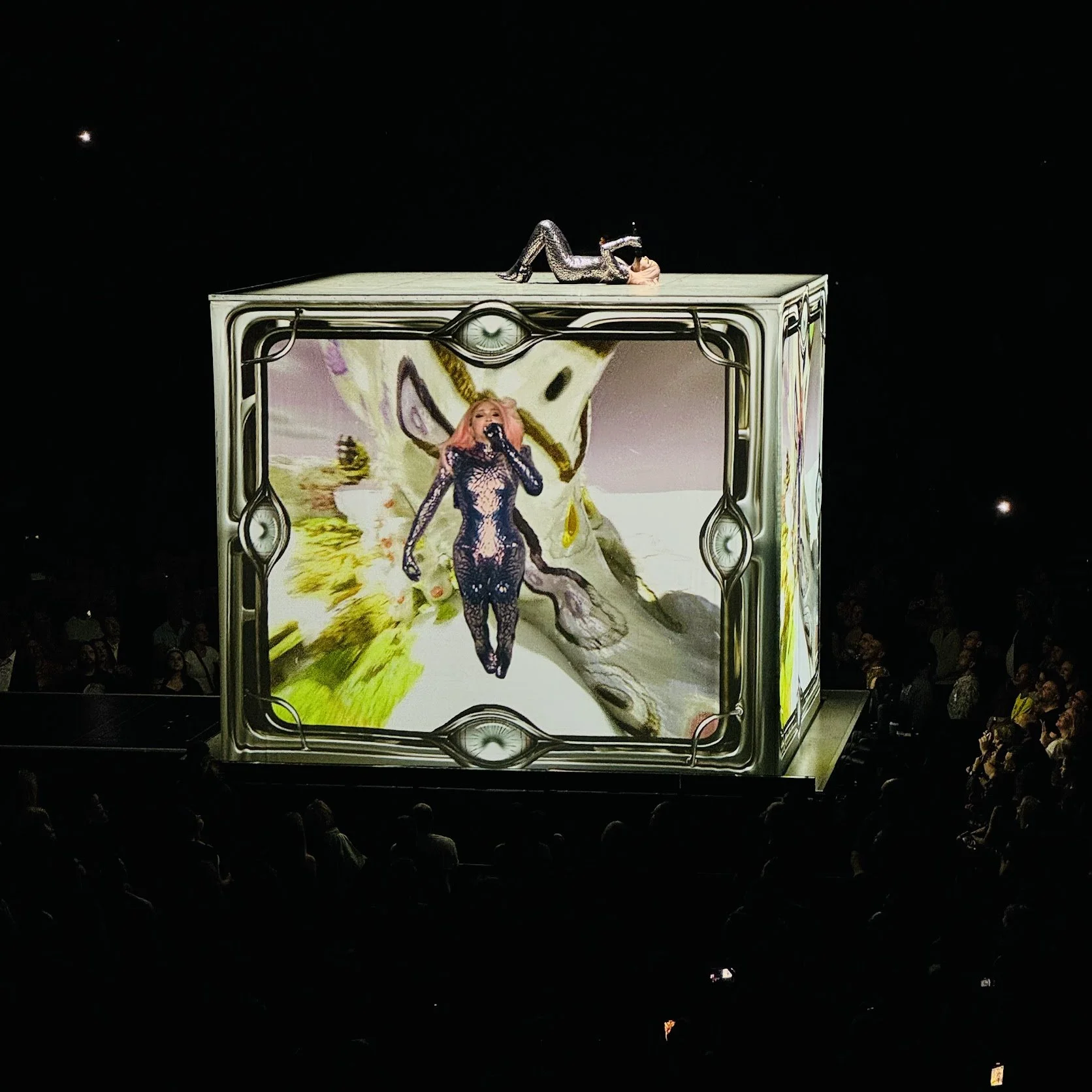
Madonna singing “Bedtime Story” in The Celebration Tour (Seattle 2024).
Yes. A few years after Bedtime Stories, Ray of Light added Hindu and Kabbala spirituality to Madonna’s ongoing theological vocabulary. The arc of Ray of Light builds to the three-song heart of the album – in an album that reflects on her experience of parenthood, “Nothing Really Matters” puts it all in perspective (Nothing really matters, love is all we need. Everything I give you all comes back to me) before “Sky Fits Heaven” articulates a kind of creed through its refrain. Between meditations on Hindu, Christian, and Kabbala revelations, Madonna sings an anthem for theological pluralism:
Traveling down this road road, watching the signs as I go
Think I’ll follow the sun, isn’t everyone just
Traveling down their own road, watching the signs as they go
Think I’ll follow my heart, it’s a very good place to start
In a brilliant transition, the song blurs into a Sanskrit chant. The musical arc mimics the experience of Hindu darshan. In its grandest form in a mandir, a ritual honoring the murti, or consecrated image of a god, builds to the moment of revelation when the curtain or door to the garbhagriha opens and reveals the face of the divine. Communion with the divine is an experience beyond ordinary language, and Madonna cleverly (and with the blessing of appropriate Vaishnava leaders) imposes the language of an obscure prayer expressing devotion to a guru, or spiritual teacher. It is an ode to divine wisdom in the guise of electronic dance music. The remainder of the album meditates on what it means to let go – You’re frozen when your heart’s not open, There’s no greater power than the power of good-bye, Like a moth to a flame only I am to blame – and what it means to embrace (including a love song to the newborn Lourdes and a stark finale about grief). Does it get any more ritual than that?!
YES! IT DOES! C2, too, gathers listeners with the search for joy, which – and I hate to be one of those “these days” people, but – is something we can all relate to these days. She invites us to join her in the place where she finds her inspiration – Come on meet me on the dance floor – and in the first third of the album, she gives us two immediately iconic songs, bolstered by their segments in the Confessions II film. As Madonna sings “Good for the soul,” dancers give life to Keith Haring’s drawings, making sensual and acrobatic combinations accented by lasers of sexual energy…you just have to see it. Anyway, the second insta-anthem comes with the invocation of a new litany of saints in “Danceteria” and a stylized revival of the legendary club. In the film, Madonna is joined by a handful of OGs from the Danceteria days (hey Debi Mazar!), while her dancers and a remarkably wide variety of celebs (Cumberbatch? really?) stand in for the rest.
Despite the utter bliss of the song and the happy memories driving it, I’m aware with each listen that Madonna is one of the few still standing from a creatively potent world – plagued by AIDS and addiction and ignored by the people in power, too many were dead, too soon. In “Vogue,” she called on the gods of Old Hollywood glamour and juxtaposed them with the legendary children of the Ballroom, but, just as the Catholic “Litany of Saints” invokes the friends of God and prophets and asks for their intercession, in “Danceteria” she invokes the names, lyrics, and images of the people who infused that space with magic, made the dance floor holy, and launched her into the cultural heavens. Martin Burgoyne. Haoui Montaug and the performers of No Entiendes. Debi Mazar. Mark Kamis and the dancers following his spin. Fab Five Freddy. Basquiat. Keith Haring. Kenny Scharf. Tony Shafrazi. Maripol. Rock Steady Crew. Crazy Legs. Break dancers. Puerto Rican boys. Nile Rodgers. David Byrne. The B-52s. The Lounge Lizards. Lou Reed. More than a sentimental namedrop, it’s an extraordinary portrait of the creative and social intersections that beautifully cluttered New York’s Lower East Side and pulsed in the veins of Danceteria. And just as the Catholic in me starts to respond “Pray for us” to each name, Madonna gives me a new mantra: Everyone here is a work of art.
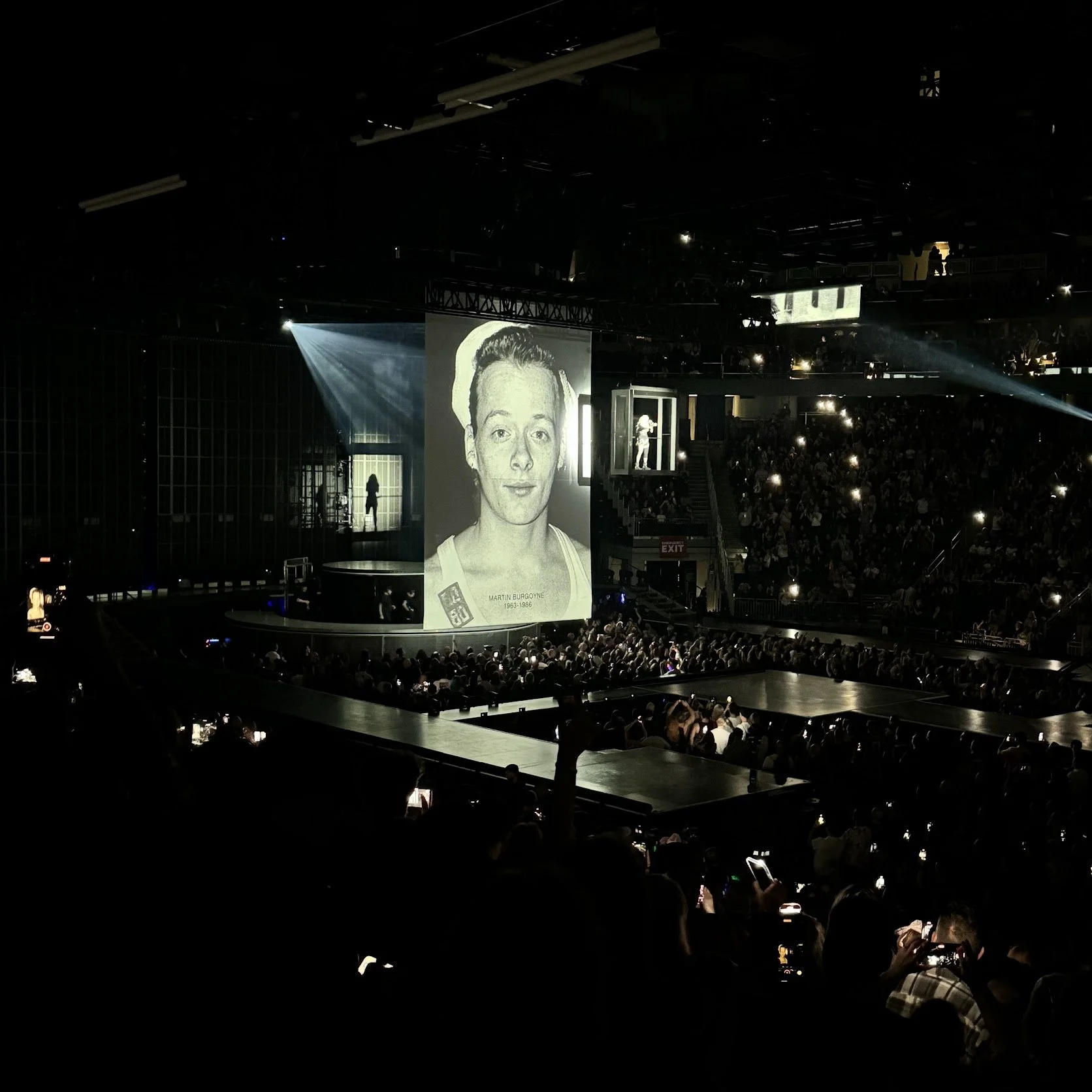
Madonna, floating before an image of Martin Burgoyne in The Celebration Tour (Seattle 2024).
With their presumed blessing, the rest of the album explores the experience of the dance floor, the relationships formed and impacted there, and, most importantly for a ritualist, how they support Madonna’s appraisal of the dance floor as a liminal and sacred space. Hooks like Everyone here is a work of art and I don’t fuck with it lead us to Call it trance, call it house, call it love without words before landing in the sanctum sanctorum. As she did in “Bedtime Story” and “Shanti/Ashtangi” she saves the most sublime experience and two deep revelations for “Love Without Words.”
The first revelation is personal and emerges from the transformation and empowerment generated on the dance floor.
We all learn from what’s outside, but love from in.
You gotta burn just like a fire, but from within.
We come from the rhythm that set us free.
As the lyrics continue by tapping new emotional wells, the music shifts to a new mood, a new dimension (I’m telling you, Stuart Price should just get all the things, all the lauds), that liberating rhythm she invoked, and she invites us to Come to the club, come into the club of love. And let me tell you, even if you’re listening through your AirPods at an unairconditioned coffee shop while typing on a freshly charged MacBook, if you close your eyes, the immediate world will disappear. An irresistible and almost primal beat builds, the mantra returns, and with a flash, Madonna’s voice bursts with the second revelation, another creed, a statement of belief, a “confession of faith,” if you will, that builds on her collected wisdom.
This is a club.
This is a temple of sweat and surrender
where rhythm replaces reason and movement when we dance.
It makes our heads turn.
The dance floor is sacred both because of the distance it provides from the world and because it opens us to broader, deeper, bigger realities. Letting go of language and logic frees us to the revelation and divinity of our bodies, our desires, and our dreams. In short: for academics, Madonna identifies the dance floor as a critical source of cultural construction, but for the rest of us, she’s giving us a map to liberation.
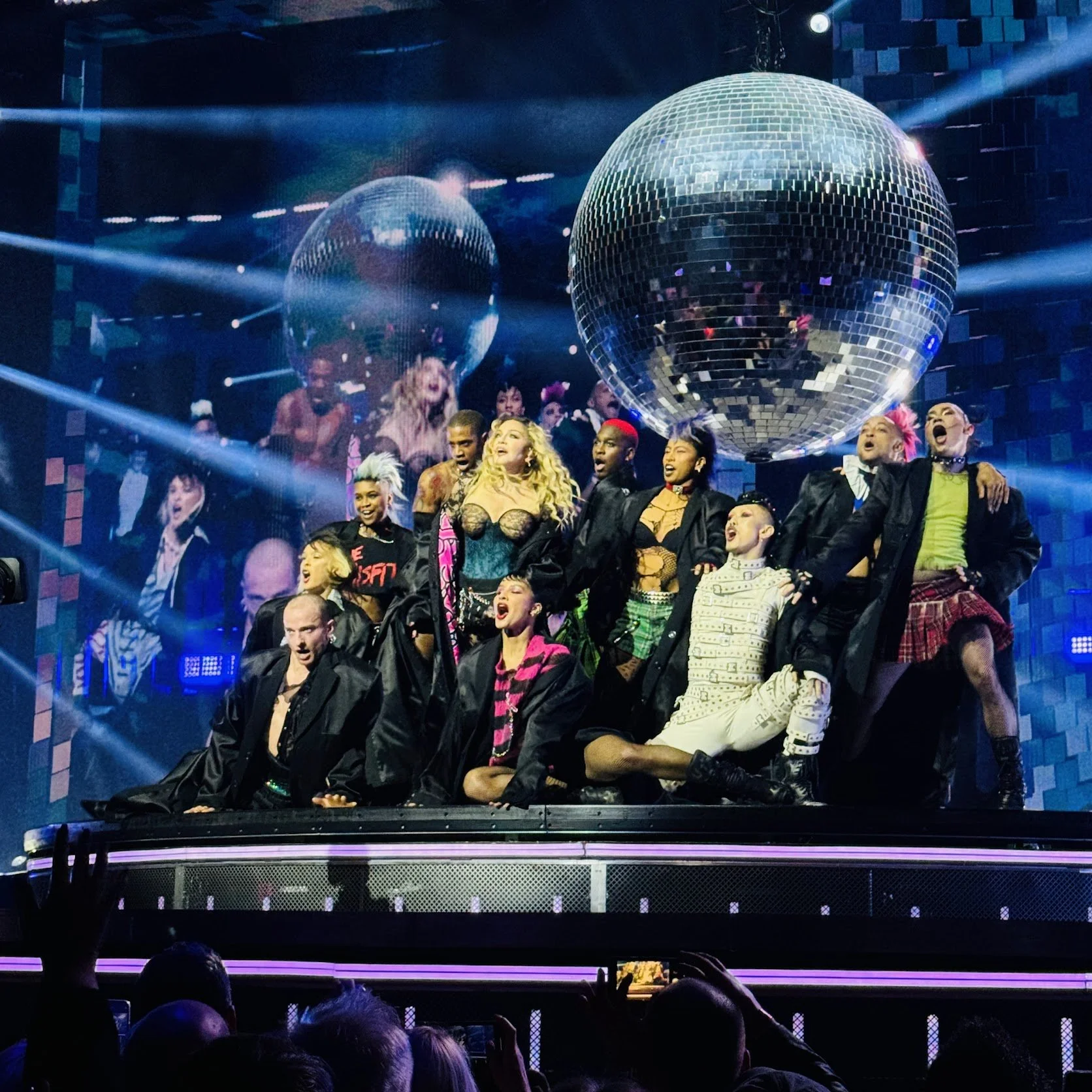
Madonna and dancers singing “Holiday” in The Celebration Tour (Seattle 2024).
Yeah, I haven’t ranted about any of that, and, can you believe, I haven’t gone online to revel in the countless references throughout the album to previous songs, performances, mentors, friends, and influences. I mean, Madonna has always been clever with callbacks, whether or not her audience always got them – I mean, how many acknowledge the callback to Like A Prayer’s “Love Song” and credit Prince as the author of the opening mantra on the first Confessions album, Time goes by so slowly? Madonna can now invoke over 40 years of lyrics and imagery – dare I say, iconography – that thrive in the American and global pop cultural mainstream (and has always been there despite what some of these “oh, suddenly I love Madonna” or “Madonna is back!” types and the people who recently “discovered” her, blah blah blah). I’m sure the haters are going to describe these Easter eggs as indulgent, and I’m sure that the most rabid fans are already racing to obsess and debate this or that word or cue or chord or shadow, but I see it a little differently. Those nuggets aren’t just “references” or “callbacks.” They’re part of the theological vocabulary and framework that she has been developing for decades.
And that reminds me. I also haven’t grabbed anyone by the collar to explain why it’s a mistake to think of C2 as a “sequel” to 2005’s Confessions on a Dance Floor(henceforth, lovingly known as C1). Yeah, I know, that’s how it’s been marketed, but I think that’s just a clever way to activate her audience. Throughout C2, references abound – sure, a few to C1, but also to songs and images throughout her oeuvre. That said, C1 and C2 are different from most of her other albums – they consciously and conscientiously step back to reflect. They pick up and develop threads Madonna started to spin in various albums, on various tracks from even decades before.
But C1 wasn’t her first album to do this: Like A Prayer was. To me, LAP capped Madonna’s first era. Where her first three albums are filled with the bops that caught the world’s attention, Like A Prayer dives deep. The title track invokes religious ecstasy (and its video juxtaposted medieval Christian mysticism and modern racism) and might be the first time she lyrically treats the dance floor as sacred space. From there, the album’s lyrics swing from anthems to moral contemplation and healing old wounds, and the album even ends with Madonna reciting an act of contrition, part of the Catholic sacrament of reconciliation (also known as, ahem, confession) in a song not so subtly called “Act of Contrition.” In both LAP and C1, Madonna takes time to reflect, but she resists pure nostalgia and any hint that our best days are in the past. Instead, she draws on her experience of the past to build the future. So, if LAP reflectively caps her first era, and C1 caps her second, from Erotica (1992), Bedtime Stories (1994), Ray of Light (1998), and Music (2000), then C2 is tying a bow on a third era that spans Hard Candy (2008), MDNA (2012), Rebel Heart (2015), and Madame X (2018). If this is true, then we can anticipate (he wonders with glee) C3,C4, C5…?
And, can you stand it, after all this, I haven’t even dared to whisper that I’ll have to revise my ranking of Madonna’s albums because, well, it’s bumped Madame X and made it to my top five.
So, forgive me, friends. In my defense, I just haven’t had the time because I just can’t stop listening to the album.
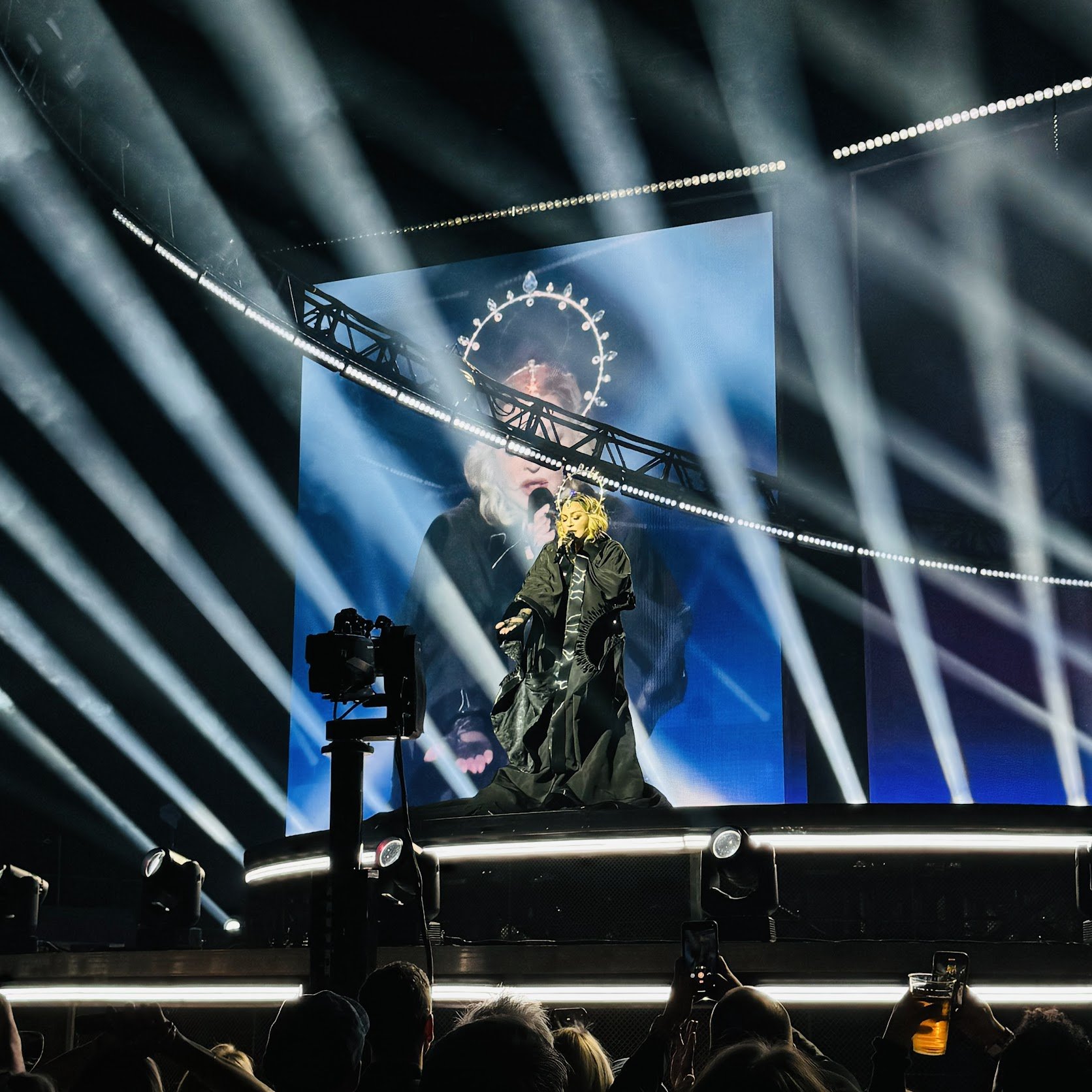
Madonna singing “Nothing Really Matters” in The Celebration Tour (Seattle 2024).