the ritual body
Different cultural and religious traditions use rituals differently, and, to varying degrees (and to varying effectiveness) they inculcate in their members an understanding of their core practices, including the purpose and meaning of the rituals themselves. Some folx adopt a practice because “it’s the way we’ve always done it,” while others can cite the original purpose or philosophical underpinnings of this or that custom. If you don’t have a tradition to draw on, you might be baffled when asked about what practices you want to include or why we do this or that, and when it comes to weddings, it’s not always clear where to start planning or how to prioritize various components.
If you rely on the imagery projected by the Wedding Industrial Complex, you might assume that the most important aspects of a wedding are the most photographed ones, such as a formal entrance (a wedding party’s procession, a parent’s accompaniment and handoff of a to-be-wed) and a big kiss at the end. And if you rely on Hollywood, you’d be forgiven for thinking that “vows” are monologues that include details about a couple’s meet-cute, jokes to make everyone laugh, tear-inducing poignancy, and dramatic declarations chock-full words like “forever” and other superlatives. Now, I hate to be “that guy,” but…
WRONG, WRONG, WRONG, oh my gods it’s all so wrong. But [Bill takes a breath and stands down], instead of ranting about the fallacies promoted by the Wedding Industrial Complex, let’s sidestep that minefield and explore a different approach. Here, I want to share two things: a natural metaphor to understand how different elements of a wedding ceremony relate to and interdepend on each other, and a starting point for talking about the most important part of every wedding: the vows.
a natural metaphor
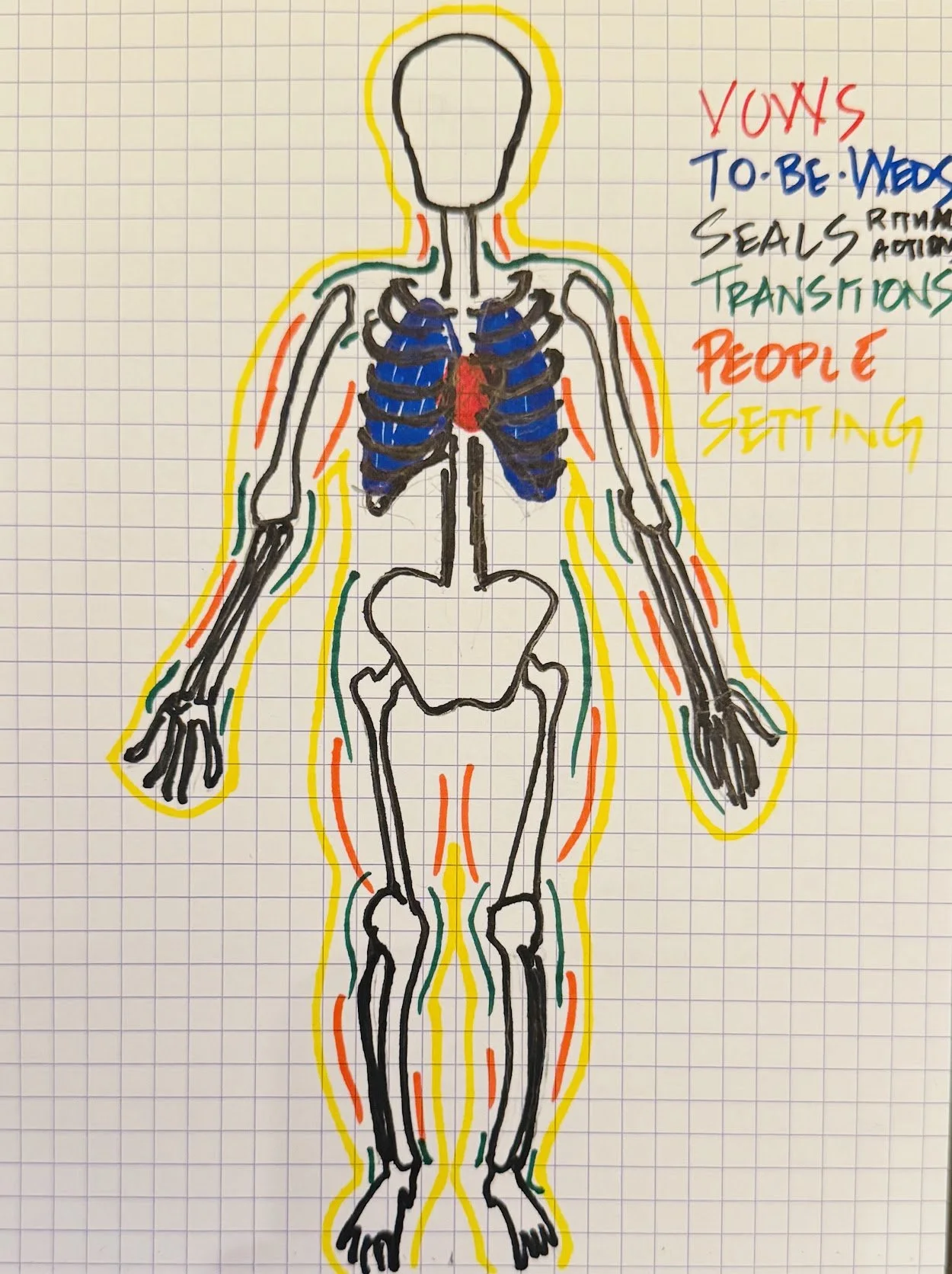
In an effort to be person-centered in my work, I think about a wedding ceremony (really any ritual) like a human body. Most bodies share the same general composition, and what we can see, like skin and hair, and what we primarily engage when one body encounters another body constitute a protective layer that shields an internal structure that itself protects and sustains the body’s most vital organs. While each layer and every bodypart interconnects and interdepends, when it comes to surviving, functioning, and thriving, some parts are more important than others…and the more important parts aren’t what you see on the outside.
Likewise, rituals and ritualized customs include different components that carry differing importance. It’s easy to get caught up in the externals–the beauty of a setting, the choreography of well-appointed people, the playlist of heart-string-plucking tracks—but those pieces don’t exist on their own. They simultaneously emerge from and impact (in ritualese, they effect and reflect) what’s inside, what’s at the core.
When it comes to weddings, think of your ceremony like a human body:
HEART: the vows — the core of the ceremony
LUNGS: to-be-weds — breathe life into vows and animate the event.
BONES: seals, ritual actions — give your ceremony a structure that enables movement and protects the heart and lungs
MUSCLES: people — convert energy into effort, enable movement and impact
TENDONS: texts — connect muscles & bones and enhance engagement
LIGAMENTS: transitions — keep the body tight & moving, keep the ceremony, well, tight & moving
SKIN: the setting — the body’s overall container, the ritual’s setting
Of course, no metaphor is perfect. Yes, I’ve forgotten all sorts of organs and anatomical considerations, but stay with me.
You are getting married: you breathe life into the ceremony, and your vows, like a beating heart, keep the essential values and nutrients pumping throughout your body. Like lungs, you can’t inhale and exhale once–your vows sustain as long as you keep breathing life into them; like a heart, it only sustains with proper care of the whole network of capacities and relationships throughout the body.
Each specific action that you include in the ceremony is a bone. Some bones are essential, but if we don’t have particular bones in our bodies, we can adapt. Sometimes, it’s easy to accommodate, and sometimes it’s debilitating or requires some extra support. Some bones are vestigial and have outgrown their usefulness, but for some incomprehensible reason have stuck around. Likewise, in a ritual, there are traditions that we maintain because they’re meaningful or at least useful; but there are others that we retain though they’re no longer useful or even get in the way.
I think of people–a wedding party, family and friends, event vendors–as muscles. They give the body strength–but there’s a reciprocal relationship between muscles, the heart, and the lungs. Muscles thrive when the heart is healthy and the lungs are clear; they suffer or atrophy without appropriate nutrition and exercise.
Tendons and ligaments give the body agility and finesse, and most of the time they do their job so well nobody pays them any mind…but, have you ever been to a wedding when it takes ten minutes for someone to move from A to B, or the officiant goes on a tangent, or they include a reading that’s popular but, on deeper reflection, is wildly offensive? Yeah. When that ACL snaps or that tendon flares, it’s painful for the whole body.
And a body’s skin reflects its overall health and requires hydration, nutrition, and activity. If a body doesn't get the proper hydration and nutrition, there’s only so much makeup and botox that can cover it up. If you make your guests sit in the afternoon sun for half an hour, you might get a cute photo or two, but you’ll also risk heatstroke and drain the energy for the rest of the event.